By 401 Tire and Truck Repairs
If you have ever peered underneath your vehicle in Kingston, you have likely noticed it. The orange-brown tint creeping across metal components. The flaking surface on pipes. The inevitable question that follows every harsh winter: How much longer does this exhaust have?
Living in Kingston means accepting a unique set of challenges for your vehicle. Between the freeze-thaw cycles, the humidity from Lake Ontario, and the generous application of road salt each winter, the underside of your truck or car fights a constant battle against corrosion.
When the time comes to replace a worn-out muffler or a rusted pipe, you will typically face two main choices: Aluminized Steel or Stainless Steel.
Both materials will get your vehicle running quietly again. However, if you plan on keeping your vehicle for the long haul in this climate, the difference in lifespan is substantial. At 401 Tire and Truck Repairs, we believe in helping Kingston drivers make informed decisions. Here is the scientific breakdown of which material truly survives longer on our local roads.
The Enemy: Why Kingston Roads Destroy Exhausts
To understand which metal wins, you first have to understand the battleground.
Unlike interior components, your exhaust system lives in a nightmare of environmental extremes. Firstly, it deals with extreme heat (sometimes over 500°F) and cold snaps that freeze components solid. Secondly, and most critically for longevity, it deals with chemical warfare.
According to automotive research, the primary cause of exhaust deterioration is exposure to moisture mixed with road salt. In Kingston, we use salt brine before storms and rock salt during them. When this salt splashes onto a hot exhaust pipe, it creates an electrolyte that supercharges the rusting process. Furthermore, the water vapor produced by your engine condenses inside the exhaust system. This “internal condensate” mixes with combustion byproducts to form acidic moisture that eats away at the metal from the inside out.
You need a metal that can handle external salt spray and internal chemical attacks. Here is how the two contenders stack up.
Deep Dive: Aluminized Steel Exhaust Systems
Aluminized steel has been the standard for factory and replacement exhaust systems for decades because it strikes a balance between cost and performance.
What Is It?
Aluminized steel starts with a base of普通 carbon steel. This steel is then hot-dipped into a bath of molten aluminum-silicon alloy. This process bonds a protective aluminum layer to the steel core. Think of it as a shield: the aluminum is meant to sacrifice itself to corrosion so the steel underneath stays solid.
The Pros
- Cost-Effective: It is significantly cheaper than stainless steel. If you are selling the vehicle in a year or two, this is likely the most economical choice.
- Heat Dissipation: The aluminum coating reflects radiant heat, which can help keep exhaust gases hotter (improving flow) and protecting underbody components.
- Availability: Most “direct fit” budget replacements are aluminized.
The Cons (The Dealbreaker in Kingston)
- The Cut Edge Problem: When manufacturers bend and weld the pipes, they cut through the aluminum coating. The raw steel edges are completely exposed. In Kingston’s salty environment, rust will start at these seams and flanges immediately.
- Sacrificial Limitations: Once the aluminum coating is penetrated by a rock chip or scratch, moisture seeps in and rusts the steel core from the inside out. You won’t see it until the pipe swells and splits.
Real-world lifespan in Kingston: Typically 2 to 5 years. If you do a lot of short trips (which prevents the system from fully drying out) and drive on salted daily roads, you are likely looking at the lower end of that spectrum.
Deep Dive: Stainless Steel Exhaust Systems
Stainless steel is often viewed as the “forever” exhaust. However, not all stainless steel is created equal. At 401 Tire and Truck Repairs, we generally distinguish between two grades: 409 and 304.
What Is It?
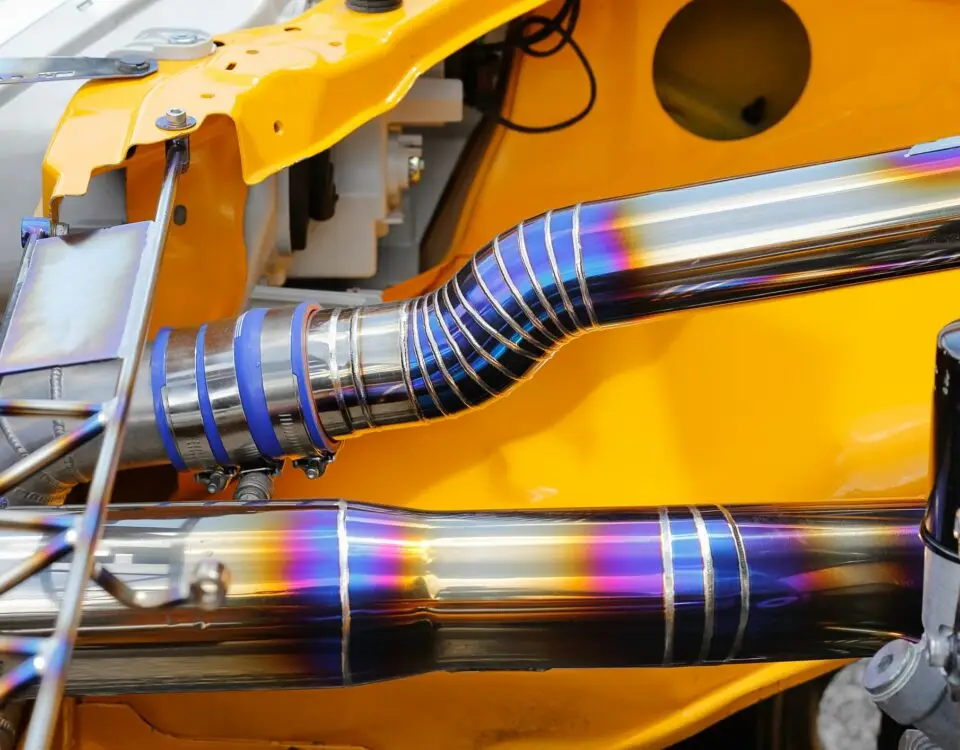
Stainless steel is an alloy. By adding Chromium and Nickel to steel, the metal creates a passive layer of chromium oxide on the surface. If this layer is scratched, it actually “self-heals” by re-oxidizing, preventing deep rust penetration.
Here is the breakdown of the two types you will see on the market:
- Grade 409 Stainless Steel (The “Factory Upgrade”): This contains about 11% Chromium and very little Nickel.
- Grade 304 Stainless Steel (The “Gold Standard”): This contains 18-20% Chromium and 8-10% Nickel.
- Behavior: Non-magnetic and more expensive.
- Corrosion: Nearly total resistance to road salt and acidic condensate. It may turn a slight golden color from heat, but it will not flake or scale.
The Pros
- Longevity: In a Kingston environment, a quality 409 system can last 5 to 10 years. A 304 system can easily outlast the vehicle itself.
- Durability: Stainless steel is harder and more resistant to physical impact from road debris.
- Internal Resistance: It holds up far better against the acidic water that pools inside mufflers during short drives.
The Cons
- The Price Tag: You will pay 2x to 4x more for stainless steel compared to aluminized.
- Welding Complexity: Not every shop can weld stainless properly. At 401 Tire and Truck Repairs, we have the equipment to do it right, but a bad weld on stainless is worse than a good weld on aluminized.
Head-to-Head: Which Survives Longer in Kingston?
Let’s settle the debate with specific data relevant to Kingston, Ontario.
Resistance to Road Salt
- Aluminized: Moderate. The aluminum layer handles light salt spray, but the exposed ends of the pipes fail quickly. Studies show that snow-mud mixtures (the slush we drive through for six months) rapidly accelerate corrosion in aluminized steel.
- Stainless: High to Excellent. 409 resists salt well (surface rust only). 304 practically ignores salt.
Resistance to Internal Moisture
- Aluminized: Poor. The inside of aluminized pipes often lacks the thick coating found on the outside. The acidic moisture sits in the muffler and eats through from the inside out.
- Stainless: Excellent. The chromium protects the interior just as well as the exterior.
The Verdict on Lifespan
- Aluminized Steel: 3-4 years (Kingston Average).
- 409 Stainless Steel: 7-10 years (Kingston Average).
- 304 Stainless Steel: 15+ years to Lifetime.
Conclusion: Stainless steel survives longer in Kingston. Significantly longer.
However, there is a nuance. If you lease your vehicle or plan to move to a drier climate in two years, an aluminized system from 401 Tire and Truck Repairs will get you through that period just fine for a fraction of the cost. But, if you own your truck or car and want to avoid another expensive repair bill in 2028, Stainless Steel is the winner.
The “Hidden Costs” of Going Cheap in Kingston
Many drivers opt for aluminized steel to save money today, but they often forget the labor costs. Replacing an exhaust requires removing rusty bolts, dealing with seized hangers, and fitting parts. If you install an aluminized system now, you will likely pay the same labor fee again to replace it in three years when it rusts out.
Conversely, paying more for a 304 stainless steel system means you likely pay for the installation once during your ownership of the vehicle.
Final Recommendation from 401 Tire and Truck Repairs
After diagnosing hundreds of exhausts in our Kingston garage, our advice is based on your vehicle type:
- For Daily Drivers & Commuters: We recommend 409 Stainless Steel. It offers the perfect balance of affordability and longevity. You might see some cosmetic surface rust, but you will not see leaks or holes for nearly a decade.
- For Trucks, SUVs, & Long-Term Owners: Choose 304 Stainless Steel. If you haul heavy loads or plan to keep your truck for 10+ years, the total corrosion resistance of 304 makes it the only logical choice.
- For Older Vehicles or Budget-First Repairs: Aluminized Steel is acceptable. If the car has 200,000 km and a failing transmission, we understand keeping the exhaust repair budget-friendly.
Maintenance Tips to Extend Any Exhaust
Regardless of which material you choose, you can fight back against the Kingston elements:
- Wash the Undercarriage: Take your vehicle to a touchless wash that offers an underbody spray, especially during winter thaws.
- Take the Long Way Home: Once a week, take a 20-minute highway drive. This heats the exhaust enough to evaporate the internal moisture that causes acidic corrosion.
If you hear a rattle, smell fumes, or notice your vehicle getting louder, do not wait. Bring it by 401 Tire and Truck Repairs. Let us help you choose the right metal for your driving habits and the Kingston climate.